
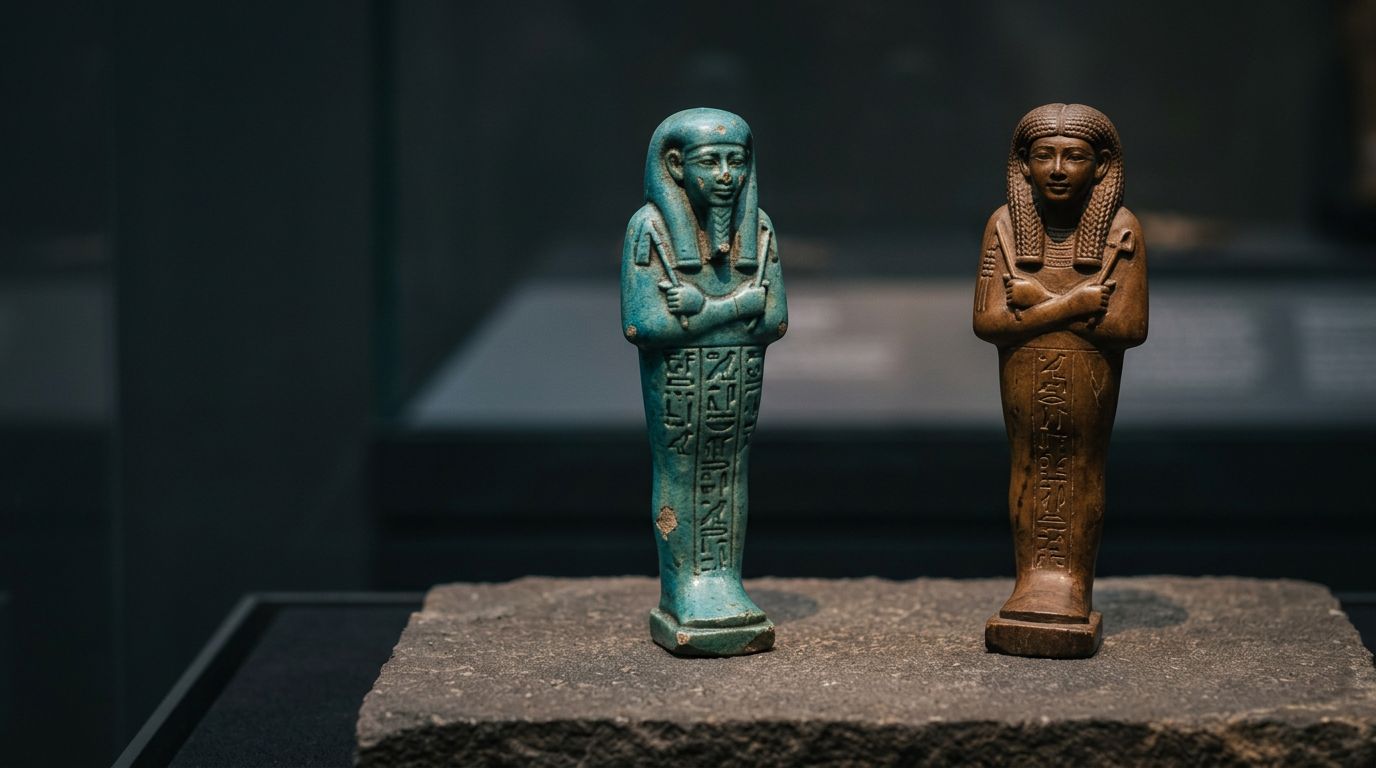
The easiest answer is that shabtis and ushabtis are related names for an ancient Egyptian funerary figurine. At first glance, a small blue-green figure may look like a decorative doll, but it was meant to serve its owner after death.
A search for shabti ushabti brings up several spellings, several dates, and a surprising amount of tiny agricultural equipment. The short answer is reassuring: shabtis, shawabtis, and ushabtis are closely related funerary figures. Their changing names reflect language, place, and time, along with a long-running hope that the dead wouldn’t have to do all the heavy lifting alone.
This post may contain affiliate links. If you make a purchase through these links, I may earn a small commission at no extra cost to you.
Key Takeaways
- Shabti, shawabti, and ushabti are related names for Egyptian funerary figures, with usage changing across periods, places, and modern catalogues.
- Their purpose was to answer for the deceased when afterlife labor was assigned, including farming, carrying sand, and irrigating fields.
- Tools, inscriptions, materials, and burial context help identify and date a figure, but the name alone is not a reliable date stamp.
- Sets could range from one figurine to the ideal workforce of 365 workers and 36 overseers, creating a calendar-shaped team for eternity.
- Chapter Six of the Book of the Dead preserves the famous shabti spell, turning a small figure into a prepared answer for its owner’s afterlife duties.
Why “shabti ushabti” has several names
The common search phrase “shabti ushabti” combines terms that often describe the same broad kind of Egyptian funerary figure. They weren’t three separate categories with hard borders. Ancient Egyptians used different words at different times, and modern scholars use spellings adapted to English.
Figures from the early Middle Kingdom are usually called shabtis. The spelling shawabti became common during the New Kingdom, especially in Theban contexts. Ushabti became the usual term during the Third Intermediate Period and later. Museum catalogues may still use “shabti” as a useful catch-all.
The words changed, but the work stayed familiar
Ushabti is linked to the Egyptian root wSb, “to answer.” That fits its purpose perfectly. When the dead were called to work, the figure would answer in their place.
The origin of shabti is less certain. Some explanations connect it with sticks or wood, which fits the simple wooden figures used in some early burials. Ancient Egyptian writing omitted most vowels, so modern spellings involve informed reconstruction rather than a direct record of everyday speech.
A name is not a date stamp
Seeing “ushabti” on a label may suggest a Late Period tomb. Often, that’s a sensible first thought. It isn’t proof.
A museum, auction catalogue, or older publication may prefer one term over another. Read the label alongside the date, materials, archaeological context, and textual evidence, including coffin texts and inscriptions. Names offer useful chronological clues, but they aren’t definitive dating evidence, so this distinction helps without telling the whole story.
What these funerary figures were meant to do
A shabti wasn’t buried as a toy, a portrait, or one of many generic servant figures. It was a substitute body with a practical purpose. If the deceased was summoned to perform afterlife labor, the figure could answer the call.
The work could include cultivating fields, carrying sand, or irrigating land in the Field of Reeds, sometimes described as the fields of Osiris. Death didn’t mean sitting under a palm tree forever. Ancient Egyptian religion imagined duties as well as rewards.
A small stand-in for a large problem
The earliest figures were often mummiform, wrapped like the deceased and holding little or nothing. They looked less like farm workers than miniature versions of the person in the tomb.
Over time, the figures became more openly workmanlike. Hands held hoes. Some carried seed baskets over their shoulders. The Metropolitan Museum’s shabti of Painedjem II describes such figures as avatars that could be called upon for manual work after death.
The coffin texts, including spell 472, preserve an early version of this arrangement. By the New Kingdom, the idea had become more formal, more widely used, and more visible in tomb equipment.
Grave goods with a voice
The figure mattered, but the words mattered too. An uninscribed shabti could still have a meaningful role among the grave goods. An inscribed one gained agency through the shabti formula, which supplied a name, a role, and a prepared response.
That makes the object feel less like a statue and more like a carefully written excuse note for the afterlife. Except this one was made of stone, wood, or glaze, and intended to last a great deal longer.
How shabtis changed through Egyptian history
The history of these figures is not a neat march toward one final design. Old forms remained in use, local habits varied, and wealthy tomb owners could commission far more elaborate sets than everyone else, even after the Middle Kingdom.
Still, the broad changes are easy to see once you know where to look.
Middle Kingdom mummies and Seventeenth Dynasty sticks
Early mummiform figurines were made from limestone and wood, as well as wax and clay, and appeared among other grave goods. The Met’s Middle Kingdom shabti of Senebimi has the classic wrapped-mummy form, with hands emerging from the binding, a design echoed in the coffin texts of the period.
During the Seventeenth Dynasty, some burials included stick shabtis, simplified wooden pieces with only a reduced human form. They can look almost disarmingly plain beside later glazed figures. Yet these servant figures held the same basic promise: the deceased would have help when labour was demanded.
The Louvre’s mummiform funerary servant shows how long a Middle Kingdom tradition of wrapped forms remained important, even after shabtis became more detailed.

New Kingdom workers and production in the Late Period and Ptolemaic Period
New Kingdom shabtis often hold farming tools and carry a bag or basket. Their inscriptions became longer, and many were made from Egyptian faience, a glazed silica-rich material rather than clay pottery. Their designs varied during the eighteenth dynasty and nineteenth dynasty, as workshops adapted them to changing funerary needs.
The tradition continued through the twenty first dynasty, when established forms still served the dead. By the twenty sixth dynasty, makers were still adapting those forms to new burial contexts.
In this later production phase, workshops used moulds to make sets that were mass produced. Standardisation enabled a whole workforce, complete with supervisors, without making the figures careless or meaningless. The Ptolemaic period continued this workshop tradition, producing large sets for the deceased.
Chapter Six of the Book of the Dead gave them their reply
The famous shabti spell appears as Chapter Six of the Book of the Dead. It is easy to picture it as a magic switch, but it worked more like a prepared statement. When a task came up, the figurine had the words needed to answer for its owner.
The Book of the Dead developed from earlier coffin texts, but it was not one fixed volume with a single standard text. It was a collection of spells, selected and adapted for different people. The shabti formula also varies by period, workshop, and available space.
What the spell asked a shabti to say
The spell identifies the deceased and tells the figure to answer when called upon to perform agricultural work. The response is often translated as “Here I am.” It is a small phrase with a serious purpose.
A green-glazed shabti in the British Museum preserves part of this wording. Bands of hieroglyphs can turn a lovely object into a named worker with a clear assignment.
A shabti did not merely accompany the dead. Its inscription could make it the dead person’s answer when work was assigned.
The Amarna interruption
During Akhenaten’s Amarna period, the Book of the Dead tradition sometimes omitted or changed traditional references to Osiris. That matters when reading an inscription. A missing Osiris reference is not always damage, bad carving, or an unfinished spell.
When traditional cults returned after the Amarna period, familiar funerary language returned too. The underlying worry about afterlife work never disappeared for long.
Why some Egyptian tombs held hundreds of shabtis
One figure could answer a call. Hundreds of ushabti figurines offered something closer to a rota. A complete workforce could include overseer shabtis, too. The best-known ideal set contained 365 worker figures, one for each day of the year, plus 36 overseers, often one for each ten-day division of the Egyptian calendar. That adds up to 401.
Not every burial had this number. Some had one shabti among their grave goods. Others had dozens. Pharaohs and high-ranking officials could have far more, especially in royal tombs.

Workers, overseers, and a calendar-shaped workforce
Overseer shabtis are often larger or visually distinct, and they may carry whips rather than hoes. Their presence makes the set feel organised rather than randomly accumulated. There were workers for the task and supervisors for the workers.
The Kushite pharaoh Taharqa, who ruled Egypt in the 7th century BC, was buried with more than a thousand ushabtis. Royal resources allowed for abundance on a grand scale. Workshop-made sets could be mass produced and standardised, yet remain meaningful. A large group also gave the deceased coverage for every imagined demand.
The set of 401 is a calendar-shaped ideal, not a rule that every Egyptian tomb had to follow.
The British Museum’s New Kingdom shabti of a named owner has Chapter Six text that lists the work these figures could be asked to do. The duties were not vague. Their long textual history also appears in coffin texts. They were physical, repetitive, and familiar to anyone living beside the Nile.
More figures did not mean a different belief
A tomb full of ushabtis did not abandon the older idea of a substitute worker. It expanded it. The deceased still needed a response to the summons. They simply had a much better-staffed answer.
How to read a shabti in a museum case
In a museum, a group of ushabti figurines may appear together in a display, so start with the label’s date and material. A wooden, wrapped form may point toward an earlier tradition, while a bright faience worker with hoes and a longer inscription may belong to a later one, perhaps the Ptolemaic period.
Then look at the hands. They tell a surprising amount of the story.

Photo by antonio filigno
Tools, text, and tiny details
Agricultural tools, including hoes, seed bags, and baskets, point toward afterlife labour. A whip may identify an overseer. Hieroglyphs can give the owner’s name, parentage, and title, while preserving a standard shabti formula for the expected response.
The colour is worth enjoying, but it should not do all the detective work. Egyptian faience became common, yet shabtis were also made of wood, stone, terracotta, bronze, and other materials. Tombs were not run by one supplier with one catalogue.
The label can only tell part of the story
Modern displays often show a shabti alone, separated from its coffin, tomb, grave goods, relatives, and fellow workers. Archaeological context brings back the missing scene.
A single figurine is a beautiful object, while repeated forms may look mass produced without being unimportant. A group can be a planned arrangement for eternity, complete with names, tools, orders, and people expected to answer.
Frequently Asked Questions
Are shabtis and ushabtis the same thing?
They are closely related names for the same broad type of ancient Egyptian funerary figure. Shabti is often used for earlier examples, while ushabti became more common in later periods, although museum catalogues may use either term.
Why did the name change from shabti to ushabti?
The spellings reflect changes in Egyptian language, pronunciation, place, and modern scholarly transcription. Ushabti is commonly connected with the Egyptian root meaning “to answer,” which suits the figure’s role as a substitute worker.
What did a shabti do?
A shabti was meant to answer when the deceased was summoned to perform work in the afterlife. Its duties could include cultivating fields, carrying sand, or irrigating land in the Field of Reeds.
Why were some tombs filled with hundreds of shabtis?
A large group could provide a complete workforce rather than relying on one figure for every task. The ideal set contained 365 worker shabtis, one for each day of the year, along with 36 overseers, though many burials had fewer.
How can you identify a shabti in a museum?
Look for a mummiform body, agricultural tools, seed bags, baskets, hieroglyphic inscriptions, and materials such as faience, wood, or stone. The date, burial context, and textual details are more reliable than colour or the label’s choice of “shabti” or “ushabti” alone.
Final thoughts
Shabtis, shawabtis, and ushabtis took different names as Egyptian language and burial customs evolved. Their central purpose remained steady. Each figure stood ready to spare the deceased unwanted work in the next life.
Once you notice the tools, inscriptions, and groups of workers, these small objects stop looking like generic museum miniatures. They become answers made solid, waiting patiently for a call meant to last forever.


