
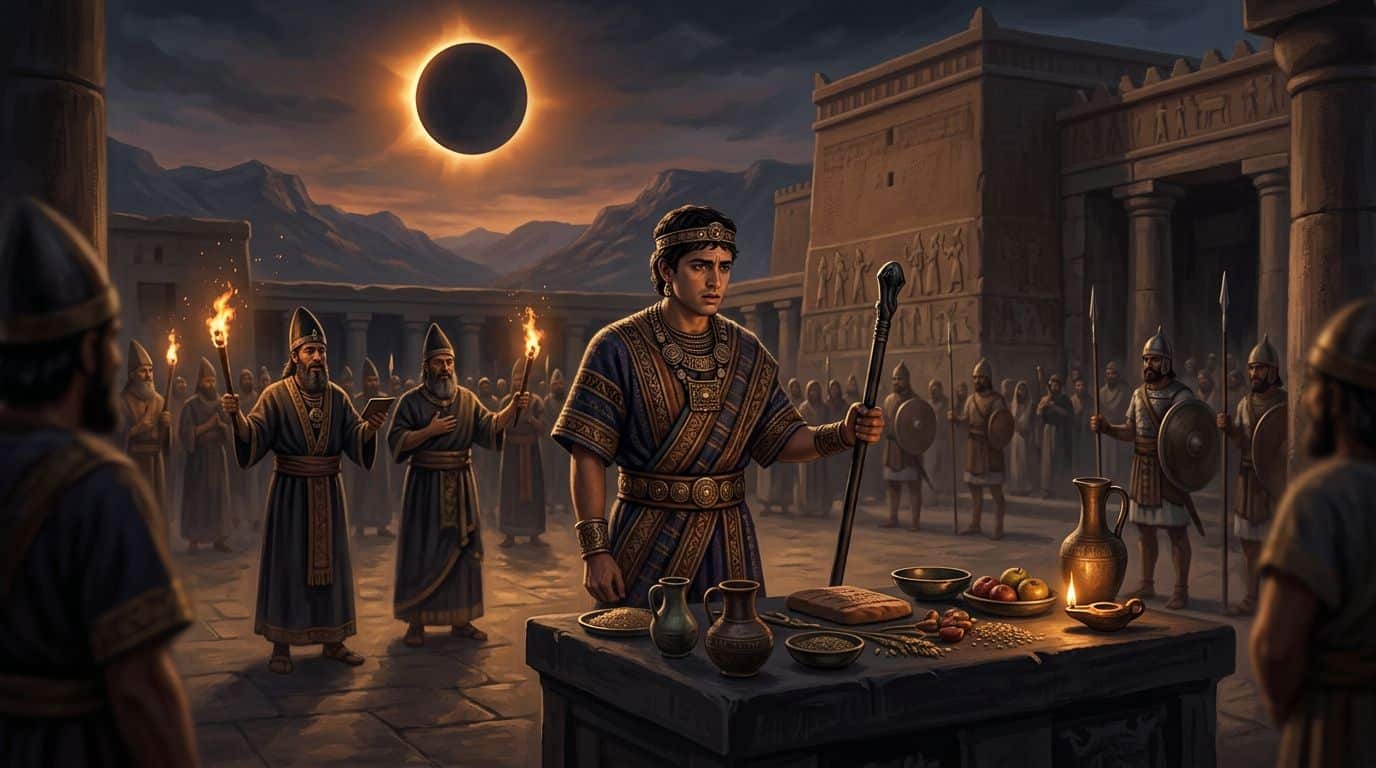
An eclipse can feel eerie even when you know exactly what causes it. For a Late Bronze Age king, it could look like a notice of death delivered across the sky.
The Hittite rite was an attempt to answer that terrifying message. When an omen threatened the ruler, the court could temporarily assign royal identity and danger to another person. The stand-in took on that role while the king was kept away from the threat.
The idea sounds like something invented for a particularly grim historical drama. The surviving tablets show that it belonged to a serious religious system, with rules, objects, spoken formulas, and lethal stakes.
This post may contain affiliate links. If you make a purchase through these links, I may earn a small commission at no extra cost to you.
What the substitute king ritual actually did
Calling it a “replacement king” can make the ceremony sound almost theatrical. It wasn’t a palace version of swapping coats for an afternoon. The substitute took on the king’s ritual identity because the danger was thought to be attached to the office itself.
Bad signs could threaten the king’s life
Hittite royal ritual texts treat evil omens as active threats. A celestial sign, illness, military disaster, or other warning could mean that a god’s anger had settled upon the king.
The ceremony sought to move that threat elsewhere. In CTH 419, a text known as the “Ritual of Royal Substitution,” a divine omen helps explain why the king’s danger is redirected to another human being. A critical edition and annotated translation of CTH 419 shows this broad logic, though it doesn’t preserve every step of the ceremony.
The goal wasn’t to argue with fate. It was to give fate the wrong man.
The tablets leave important gaps
Hittite records are clay tablets from a royal palace archive, often broken, copied, and preserved in fragments. That means historians can identify the rite’s broad purpose without pretending every moment survives in full.
The Hittite kingdom flourished in Anatolia during the second millennium BCE, in a Bronze Age setting many centuries before Alexander the Great. Its ritual archives contain healing rites, purification ceremonies, treaties, prayers, and substitution rituals involving people and animals. An overview of Hittite rituals shows how often impurity and danger were treated as things that could be carried away.
That background matters. Royal substitution wasn’t an isolated burst of palace panic. It belonged to a wider religious habit of moving danger from one place to another.
Why eclipses could frighten a palace
An eclipse was not merely a striking event overhead. In ancient Near Eastern courts, it could be read as one of many ominous signs aimed at a country, city, army, or king. When the sign seemed to threaten the ruler, the court could respond through a substitute king ritual.

Omen reading had rules, not guesswork
Court diviners watched the moon, sun, planets, weather, animal behavior, and unusual births. They compared what they saw with established traditions for reading astrological omens. The position of an eclipse, the heavenly body involved, and the part of the sky affected could alter the reading.
A solar eclipse carried particular weight because the sun was linked with royal power. A lunar eclipse could also place the king in danger. Not every eclipse brought evil omens, so the court judged whether the event targeted the ruler and signaled an evil destiny. It also assessed how severe the threat appeared.
For a kingdom built around a living monarch, this was public business. If the king fell, military command, diplomacy, food supply, succession, and divine favor all looked less secure.
Assyria provides the fuller comparison
The fullest records of šar pūhi come from first-millennium Assyria, not Hatti; the Akkadian term refers to a replacement ruler. An academic study of the Assyrian šar pūhi ritual discusses its connection to court ritual. The Enuma Anu Enlil omen corpus helps explain the wider interpretive environment in ancient Mesopotamia. It doesn’t prove the Hittites used the same text.
In the Neo-Assyrian empire, king Esarhaddon ruled Assyria from 681 to 669 BCE and is often linked with documented performances. His court relied on trained scholars, including a chief exorcist, to anticipate the event. A dangerous date might therefore be known before the sky darkened.
Still, Assyrian evidence about a substitute king and queen isn’t an instruction manual for the Hittite court. The Hittite texts are older and less complete. The traditions share a ritual grammar, but not every detail.
How the ritual changed a person’s status
The substitute king ritual changed a man’s status for the duration of the rite. A man who had never been king was treated as one in the eyes of the ceremony.

The substitute did not need royal blood
One Hittite text identifies a prisoner of war as the chosen man. That detail is difficult to ignore, but it doesn’t show that every substitute came from the same background.
The chosen man’s killing and expendability invite comparison with human sacrifice. The surviving text, however, describes a specific substitution rite, not a general sacrificial system.
The chosen man was anointed, clothed, and named as king. The chief exorcist oversaw the ceremony, giving him royal regalia and placing him on the royal throne. These acts made him able to receive the evil destiny meant for the real king.
The fuller Assyrian version could give the temporary ruler a young woman as queen. Royal clothes, a throne, attendants, and formal titles made the temporary reign visible. There was no need for a physical resemblance. The ceremony cared about the office, not a convincing face.
The danger was transferred, not ignored
Ritual speech and symbolic actions pushed the king’s predicted death onto the chosen man. The threatened lifespan or divine displeasure became something a properly prepared body could receive instead.
One Hittite version unfolds across two nights. Its purpose is clear: the monarch must survive the fate announced against him, while the substitute receives it instead.
The substitute was not there to imitate the king for show. He carried the danger attached to kingship.
That logic may feel alien now, but it was internally consistent. If a god had announced a death, the ritual did not ask the god to withdraw the announcement. It arranged for the death to land elsewhere.
Where the real king went, and how the ritual ended
The substitute sat in the dangerous place. The actual ruler had to step away from it.
The real ruler withdrew from public view
The Hittite tablets do not preserve every practical detail of the monarch’s absence. Their surviving text gives a two-night sequence. Better-documented Assyrian material describes the monarch withdrawing from public life while the substitute held the exposed role.
Some accounts say the ruler adopted the humble identity of a farmer during this period. It is a strange image, a monarch with armies and palaces temporarily pretending not to be a monarch at all. Yet it fits the ritual’s purpose. The rite sought to redirect an evil destiny when evil omens made visibility dangerous.
The Hittite timetable lasted two nights, a sequence that belongs to the substitute king ritual. Assyrian sources instead describe a formal period of 100 days. One case from the Neo-Assyrian empire involved king Esarhaddon after a lunar eclipse. That chronology shouldn’t be imported into Hittite evidence.
The substitute’s death closed the ceremony
The Hittite substitute was ultimately killed. The outcome resembles human sacrifice, though sources distinguish analogy from technical classification.
In the Assyrian form, the substitute king and queen were also put to death once the dangerous period had passed. The actual ruler then returned and underwent ritual purification.
This is the point where modern retellings often become careless. They blend Hittite fragments, Assyrian palace records, legendary kings, and later stories into one smooth tale. The broad pattern is real. The exact sequence changed across time and place.
The ritual also put power in the hands of court specialists
A king may have sat on the throne, but he didn’t interpret an eclipse alone. At the royal palace, diviners, scribes, exorcists, and ritual experts guarded specialized knowledge. A chief exorcist could help turn that knowledge into action.
Omen experts could remove a king from view
A court scholar who judged an omen dangerous could set a major chain of events in motion. The king’s public appearances might stop, and a substitute could be appointed. In ancient Mesopotamia, Enuma Anu Enlil recorded formal omen knowledge, but it isn’t direct Hittite evidence. Palace routines changed around a threat that only trained interpreters could define.
That didn’t make every priest a cynical manipator. It does show that religious expertise had political force. An omen report could affect who appeared in public, who wore royal clothing, and who was allowed near the king.
The substitute king ritual shows a court trying to control uncertainty with procedure. Its answer to fear wasn’t improvisation. It was a tightly managed transfer of risk.
Hittite and Assyrian rites should not be flattened together
Scholars still debate how directly Hittite and Mesopotamian substitution rites are connected. Some see a shared pattern across ancient Mesopotamia. Others stress that the Hittite rite looks more like a scapegoat ritual than the fully developed Assyrian substitute monarchy.
A study of Hittite and Luwian substitution rites places royal substitution among broader purification practices. That is a useful corrective to dramatic retellings that treat Hatti as a carbon copy of Assyria.
The Chronicle of Early Kings preserves the story of Isin’s Erra-imitti and Enlil-bani in ancient Babylonia. The story predates Alexander the Great and belongs to a separate, fascinating tradition. The Chronicle of Early Kings cannot serve as direct proof of how every Hittite ceremony worked.
Frequently Asked Questions
What was the Hittite substitute king ritual?
The ritual redirected an evil destiny threatening the king toward another person. That substitute was given royal identity through clothing, anointing, titles, and a throne before being killed at the ceremony’s end.
Did an eclipse always require a substitute king?
No. Court diviners judged whether an eclipse or another omen specifically threatened the ruler and how serious the danger appeared. A substitute was appointed only when the omen called for that response.
Who could become the substitute king?
The substitute did not need royal blood, and one Hittite text identifies a prisoner of war as the chosen man. The surviving evidence does not show that every substitute came from the same social background.
What happened to the real king during the ritual?
The real ruler withdrew from public view while the substitute occupied the dangerous royal role. The Hittite evidence preserves a two-night sequence, while the better-documented Assyrian rite describes a much longer period and should not be imported directly into Hittite history.
Was the ritual the same as human sacrifice?
The substitute’s killing resembles human sacrifice, but the surviving texts describe a specific substitution rite rather than a general sacrificial system. Scholars therefore distinguish the ritual’s lethal outcome from the broader classification of human sacrifice.
Final thoughts
The substitute king ritual answered a frightening idea: the sky had named the king for death. It redirected that evil destiny toward a substitute, giving the real king a chance to survive while preserving royal order.
The surviving evidence requires careful reading, not a tidy legend. Hittite tablets show an older form of royal substitution, while Assyrian records preserve a fuller parallel. The Assyrian version, the Babylonian story, and the execution of its substitute should not be treated as one timeless formula or simply labeled human sacrifice.


